


FSPCA Preventive Controls for Human Food Course
Course summary:
This three-day, instructor-led course serves as the standardized curriculum recognized by the U.S. Food and Drug Administration (FDA) for meeting the training requirements under the Preventive Controls for Human Food (PCHF) rule. Participants gain the knowledge and skills needed to develop, implement, and maintain a robust Food Safety Plan that complies with FSMA regulations. Through practical examples, interactive discussions, and real-world scenarios, this course equips food industry professionals to confidently fulfill the role of a Preventive Controls Qualified Individual (PCQI).
Key Learning Objectives:
-
Understand the regulatory requirements of the FSMA Preventive Controls for Human Food rule
-
Conduct hazard analysis using a risk-based, scientific approach
-
Identify and implement preventive controls (process, allergen, sanitation, supply-chain)
-
Develop and validate process preventive controls
-
Establish monitoring, verification, and corrective action procedures
-
Create and maintain required records to demonstrate compliance
-
Build and manage a complete, compliant Food Safety Plan
-
Apply practical tools and templates to streamline implementation
Who Should Attend
This course is perfect for professionals overseeing food safety, including Quality Assurance and Control personnel, Production and Operations Managers, Regulatory team, R&D, Consultants and auditors, and Individuals seeking PCQI certification for FSMA compliance, including:
-
Facilities that manufacture, process, pack, or hold human food (21 CFR 117.1)
-
Facilities required to register with FDA under sec. 415 of the Food, Drug, & Cosmetic Act
-
Applies to food to be consumed in the United States
No formal prerequisites are required. However, participants will benefit from prior knowledge of basic food safety principles, HACCP or preventive controls concept.
Program Outline
Day 1
-
Food Safety Plan Overview for Preventive Controls for Human Food
-
cGMP and Prerequisite Programs for Human Food
-
Biological Food Safety Hazards for Human Food
-
Chemical, Physical and Economically Motivated Food Safety Hazards for Human Food for Human Food
-
Preliminary Steps in Developing a Food Safety Plan for Human Food
-
Hazard Analysis for Human Food
Day 2
-
Determination of Preventive controls for Human Food
-
Process Preventive Controls for Human Food – Parameters and Values, Including Critical Limits
-
Process Preventive Controls for Human Food - Monitoring and Corrective Action
-
Process Preventive Controls for Human Food - Verification and Record Keeping
-
Food Allergen Preventive Controls for Human Food
Day 3
-
Sanitation Preventive Controls for Human Food
-
Supply Chain Preventive Controls for Human Food
-
Food Safety Plan Implementation and Management for Human Food
-
Recall Plan for Human Food
-
Regulation Overview: Current Good Manufacturing Practice, Hazard Analysis, and Risk Based Preventive Controls for Human Food
Overview
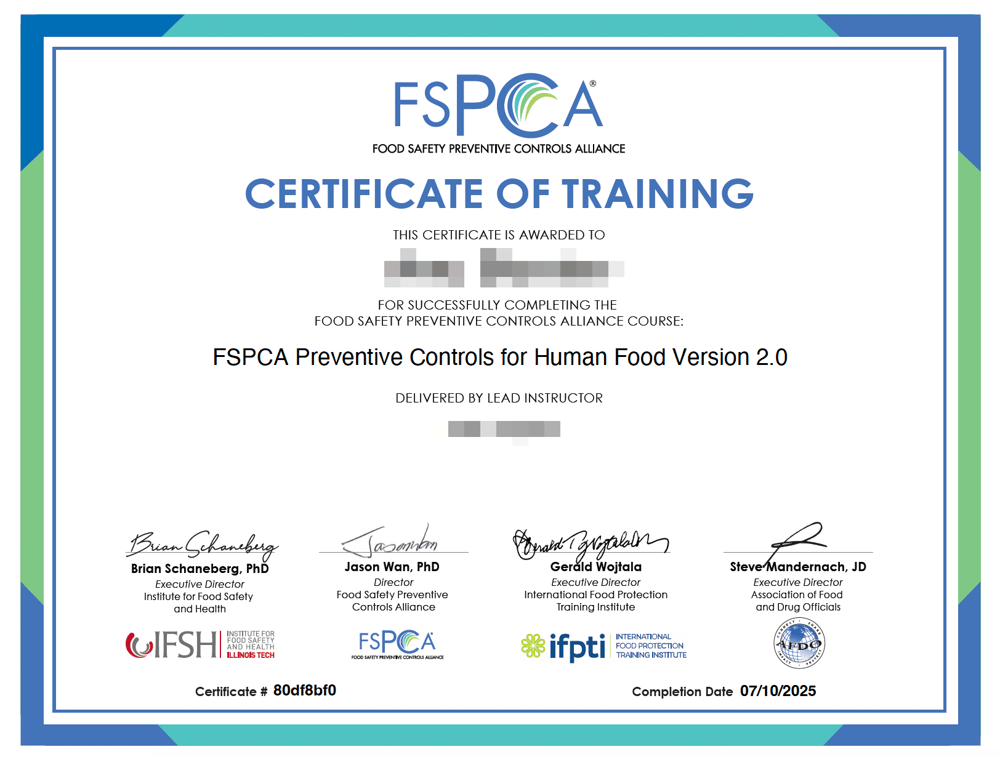
Upon successful completion of the course, participants will receive an FSPCA Certificate of Training, which is included in the registration fee.
Anu Bernier MSc.
Anu Bernier, M.Sc., is the Director of Decoding Food Safety Ltd., where she bridges the gap between complex scientific regulations and practical, hands-on industry application. With extensive experience across diverse sectors — including Dairy, Bakery, Cannabis, and RTE meals — Anu specializes in guiding businesses through GMP implementation and GFSI certifications like BRCGS, SQF, and FSSC 22000. As an FSPCA Lead Instructor, she is dedicated to helping food businesses build resilient safety systems with clarity and confidence. When she isn’t in a facility or a classroom, Anu stays active through every season — whether she’s snowboarding, biking, or perfecting her latest bake.

Join the Next Cohort
Strengthen your professional profile and gain a nationally recognised certification that demonstrates your commitment to excellence in food safety. Enroll today to secure your place on the next Hazard Analysis course with NEMIS Academy.